Localisation and regional development seen as key to driving auto sector growth

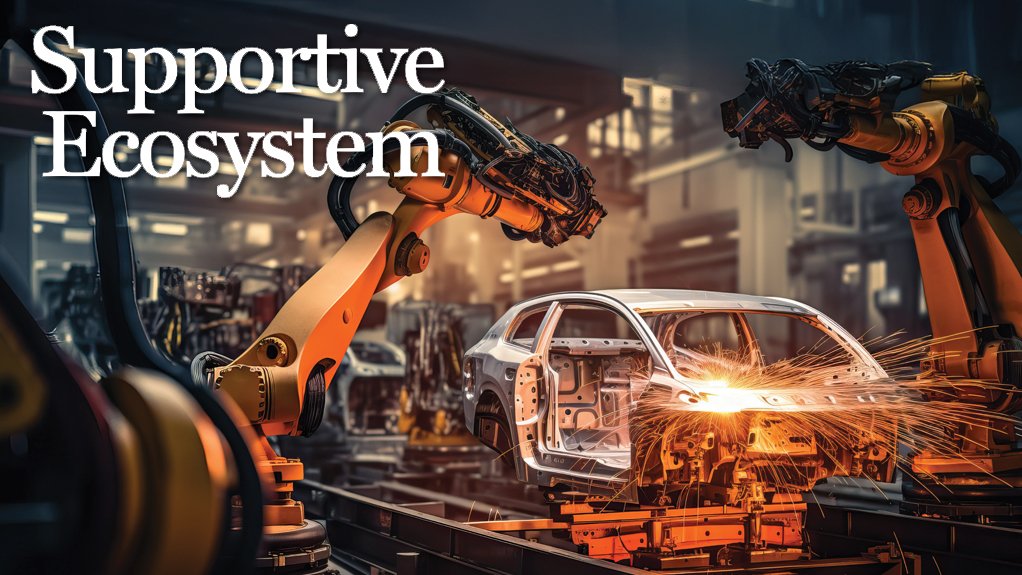



With more Chinese and Indian automakers showing growing interest in shifting from semi-knocked down (SKD) assembly to completely knocked-down (CKD) production in South Africa, industry experts agree that CKD production lies at the heart of value-addition within the industry’s ecosystem.
India-headquartered Mahindra has an SKD pickup truck assembly plant in Durban, while Chinese manufacturers Beijing Automotive Industry Corporation (BAIC) and First Automobile Works (FAW) operate SKD plants in the Coega Industrial Development Zone, in the Eastern Cape.
BAIC produces the B40 Plus and X55 Plus passenger car models, with local assembly of the B30 sports-utility vehicle scheduled to start early this year, while FAW assembles heavy-duty trucks.
Indian automaker Tata Motors has a truck assembly plant in Rosslyn, Pretoria, where light-, medium- and heavy-duty trucks are assembled from SKD kits.
Chinese carmaker Chery – which produces the Omoda and Jaecoo brands – is conducting a feasibility study to establish a vehicle assembly plant in South Africa, while Chinese pickup manufacturer Foton plans to join BAIC at its facility with the CKD production of the Foton Tunland bakkie.
Both naamsa | the Automotive Business Council CEO Mikel Mabasa and Trade, Industry and Competition Minister Parks Tau confirmed last year that Chinese and Indian automotive manufacturers are considering establishing or scaling up to CKD operations in South Africa.
The shift from SKD to CKD production marks a fundamental change in local vehicle manufacturing, with CKD operations focusing on full assembly from individual components, which requires more investment in supply chains and workforce training. SKD operations, meanwhile, involve importing partially assembled vehicles, or kits, and completing final assembly locally.
Ahead of these decisions and investment being secured, business school Toyota Wessels Institute for Manufacturing Studies executive director Professor Justin Barnes emphasises that SKDs offer little value to South Africa, warning that shifting the production base in this way would only erode local manufacturing.
He adds that the country has successfully undertaken CKD production for more than 70 years, but the economics are undermined when production drops below 20 000 units a year for a capital investment of at least R4-billion.
National Association of Automotive Component and Allied Manufacturers (NAACAM) policy and regulatory affairs head Beth Dealtry agrees, pointing out that SKD operations involve no component localisation, as items are imported.
She adds that a loophole in South Africa’s tariff duty system benefits SKD production, which erodes the business case for existing and new CKD plants: “We currently have a policy programme that benefits assembly instead of localisation,” she explains.
NAACAM has long called for a review of the country’s complex rebate system and the level of market protection offered to local original-equipment manufacturers (OEMs), which makes importers more competitive in the local market.
Dealtry argues that bottom-up competitiveness should be encouraged and supported to make components as competitive as possible, rather than simply incentivising OEMs to localise. She believes there are “quick win” opportunities for suppliers already in the market, particularly if changes are made to the tax regime.
Barnes agrees, saying that the ad valorem tax is far too high for cheaper and mid-range vehicles, which reflects a structural problem.
Supportive Ecosystem
Barnes says the Automotive Master Plan 2035 is clear: the domestic market needs to be optimised, and regional value chains developed.
“We have done neither, and that has exposed us to global shocks. Fixing those things, even in a small way, could have massive positive impacts on the industry,” he states.
Naamsa chief policy officer Tshetlhe Litheko also cites the Master Plan’s aims to increase local production through CKD assembly and simulating regional demand for South Africa’s vehicles.
“We need to localise content to such an extent [that] South African suppliers have 60% input in the vehicles we produce. This requires thriving infrastructure, including logistics at ports, and an environment where skills and transformation form part of community inclusion,” he elaborates.
Dealtry points out that supplier development and localisation have followed varying trajectories during the past few years. While some progress has been made with supplier development, the benefits are not filtering through the entire value chain.
“Tier 2 and 3 suppliers need more support. We are currently at 40% local content at OEM level and at about 50% at Tier 1 level. We are struggling to see more growth in this regard,” she says.
Barnes adds that there is a "buying-down trend" locally, with a range of importers eroding local market share, partly because of the country’s unsupportive manufacturing ecosystem..
“We have pockets of excellence in South Africa. From an operational capability and efficiency perspective, we are on par with other automotive manufacturing countries, such as Mexico, Thailand and Malaysia. However, most other countries have a healthier ecosystem, where infrastructure works, electricity is cheaper, and it is safer to operate.
“This . . . operating environment means an unlevel playing field in the global value chain,” he elaborates.
For Barnes, there is “no chance” that South Africa will meet the Master Plan’s target of producing 1.2-million units by 2035.
He acknowledges that the industry is in a vulnerable position but remains confident that its existing capabilities and resilience can drive growth in employment, production and local content, provided there is no serious decline.
From a banking point of view, Nedbank manufacturing national manager Amith Singh says there is no innovation required in new offerings from the banking sector to support the automotive industry.
Rather, he suggests, banks should focus on understanding the whole ecosystem and value chain, working alongside companies and stakeholders to identify where value can be added.
“Products are offered by all the banks, but the utmost important thing is serving as an effective conduit and having effective partnerships with industry bodies, for example.”
He adds that banks should go beyond merely funding new machinery to being a financial partner for the industry that understands the nuances of the ecosystem.
Regional Development
With South Africa’s automotive production capacity outpacing local demand for new vehicles, and some countries making it difficult to export to and sell in their domestic markets, the experts suggest that companies, government and other partners start driving volume growth across the region.
Litheko notes that Africa has about 110- million vehicles for a 1.3-billion-strong population, with a per capita spend of R2 700 – higher than that of India – and 200-million vehicles “short” of where it could be. Africa’s middle-class growth is outpacing South Africa’s, making access to finance a critical factor in buying new vehicles.
He adds that there is potential to drive regional market development through a much more concentrated approach and deliberate efforts to support local manufacturing.
Barnes agrees, pointing out that Africa could be buying six-million new vehicles a year by 2050.
However, the biggest challenge to deeper market penetration in Africa is imported used vehicles, which will “[remain] opportunities forever unless someone stands up and bans the importation of used vehicles”.
He adds that Namibia imports 10 000 used vehicles every year, owing to the absence of incentives not to do so.
“The consequence is that they are not going to shift towards a new-vehicle-only market unless South Africa can build a regional value chain and get them locked in as a partner, lest we continue to operate in highly distant global markets with various political, economical and technological shifts.”
Barnes cites Egypt, Morocco and Côte d’Ivoire as African countries that have made strides to ban used-vehicle imports.
Consultancy EY Africa associate director Hugo van Wyk sums up the experts’ consensus, saying that a major partnership is essential to move forward and fully understand South African automotive companies’ options: “We need action in this industry, and we have the right role-players to move it in the correct direction. We need to understand where the biggest ‘bang for our buck’ opportunities lie.”
The experts unpacked various issues plaguing the automotive sector during a webinar hosted by Creamer Media on November 26.
Article Enquiry
Email Article
Save Article
Feedback
To advertise email advertising@creamermedia.co.za or click here
Research Reports

Projects

Latest Multimedia

Latest News

Showroom
ISO-certified Condra manufactures overhead cranes, portal cranes, cantilever cranes and crane components: hoists, drives, end-carriages, brakes and...
VISIT SHOWROOM
Roytec Global is an international company specializing in liquid / solid and mineral separation technologies for the Mining and Industrial sectors.
VISIT SHOWROOM

Press Office
Announcements
What's On
Subscribe to improve your user experience...
Option 1 (equivalent of R125 a month):
Receive a weekly copy of Creamer Media's Engineering News & Mining Weekly magazine
(print copy for those in South Africa and e-magazine for those outside of South Africa)
Receive daily email newsletters
Access to full search results
Access archive of magazine back copies
Access to Projects in Progress
Access to ONE Research Report of your choice in PDF format
Option 2 (equivalent of R375 a month):
All benefits from Option 1
PLUS
Access to Creamer Media's Research Channel Africa for ALL Research Reports, in PDF format, on various industrial and mining sectors
including Electricity; Water; Energy Transition; Hydrogen; Roads, Rail and Ports; Coal; Gold; Platinum; Battery Metals; etc.
Already a subscriber?
Forgotten your password?
Receive weekly copy of Creamer Media's Engineering News & Mining Weekly magazine (print copy for those in South Africa and e-magazine for those outside of South Africa)
➕
Recieve daily email newsletters
➕
Access to full search results
➕
Access archive of magazine back copies
➕
Access to Projects in Progress
➕
Access to ONE Research Report of your choice in PDF format
RESEARCH CHANNEL AFRICA
R4500 (equivalent of R375 a month)
SUBSCRIBEAll benefits from Option 1
➕
Access to Creamer Media's Research Channel Africa for ALL Research Reports on various industrial and mining sectors, in PDF format, including on:
Electricity
➕
Water
➕
Energy Transition
➕
Hydrogen
➕
Roads, Rail and Ports
➕
Coal
➕
Gold
➕
Platinum
➕
Battery Metals
➕
etc.
Receive all benefits from Option 1 or Option 2 delivered to numerous people at your company
➕
Multiple User names and Passwords for simultaneous log-ins
➕
Intranet integration access to all in your organisation